
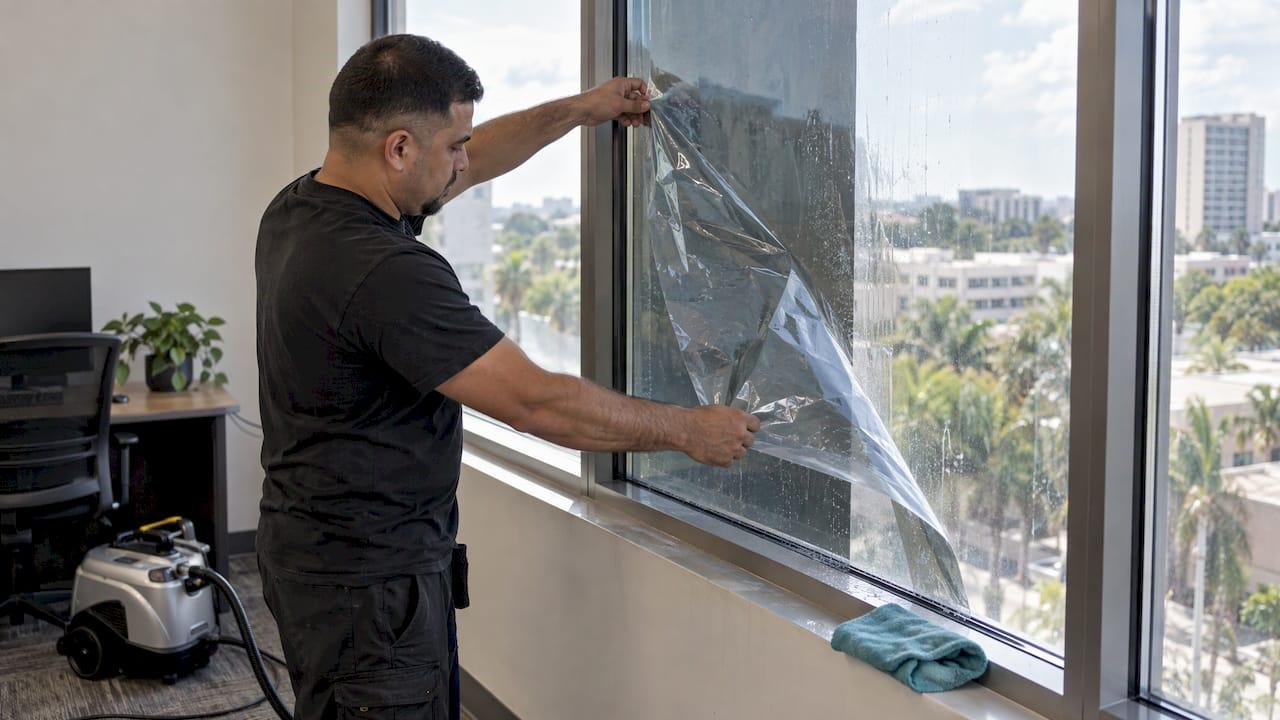
You have three realistic ways to get old tint off a window: hire a professional to do it, steam it off yourself, or heat and peel it. For most Miami-Dade drivers, homeowners and business owners, the best choice is a professional who comes to you. Old tint removal with us starts at $50 and goes to $150, depending on the job, and we do it at your home or office, so you never sit in a shop waiting. The rest of this guide explains each option, what it takes, and where it goes wrong.
TL;DR
- Old, purple, bubbling or peeling tint should come off before new film goes on. New film over old film or leftover glue fails.
- Our old tint removal is priced at $50 to $150 per job, and we do it where your car, home or office is parked or located.
- Rear windows are the risk point: the defroster lines can be cut by a metal blade or by peeling across them.
- Home and office glass is different from car glass: heat can crack double-pane units, and ammonia can harm coated glass.
- If you plan to retint, having the removal and the new ceramic film done in one visit saves a step.
Table of Contents
- Why old tint needs to come off
- Your tint removal options at a glance
- Option 1: Mobile professional removal
- What removal actually involves
- Option 2: Steam removal
- Option 3: Heat gun and peel
- Option 4: The sun, trash bag and ammonia method
- The rear window: the part most people get wrong
- What about WD-40 and adhesive remover?
- Cars versus homes and offices
- What tint removal costs in Miami
- When to call a professional
- Our approach to old tint removal
- Get old tint removed at your location
- FAQ
- Sources
Why old tint needs to come off
Window film is a thin polyester layer held to the glass by an adhesive. Over years of Florida sun, dyed films fade to purple, the adhesive breaks down, and bubbles or peeling edges appear. Once that happens, the film no longer gives you the heat and glare control it was installed for, and it can block your view.
There are two practical reasons to remove it rather than leave it:
- Visibility and appearance. Bubbles, haze and peeling edges are distracting, especially on a windshield band or side mirrors' sightline.
- A clean base for new film. New tint needs bare, clean glass. Film applied over old adhesive or old film can trap dirt and show every flaw underneath. We cover this in more detail in our guide on removing old tint before a retint.
If your tint is only slightly faded and still firmly stuck, you do not have to remove it right away. But once it bubbles, peels or turns purple, removal is the next step.
Your tint removal options at a glance
| Option | Who does the work | Time per car | Main risk | Best for |
|---|---|---|---|---|
| Mobile professional removal | A trained installer at your location | Usually one visit | Low, since the installer handles heat and blades daily | Cars, SUVs, homes, offices, anyone who wants it done right |
| Steamer | You | Several hours | Moisture in door panels and electronics, slow work | Careful DIYers with the right tools |
| Heat gun and peel | You | Several hours | Cracked glass, melted trim, cut defroster lines | Experienced DIYers on car glass |
| Sun, trash bag and ammonia | You | Several hours plus a hot, sunny day | Ammonia fumes, drips onto interior surfaces | People with no tools and plenty of patience |
The first row is the one we recommend and the one we offer. The sections below walk through what each method involves so you know what you are choosing.
Option 1: Mobile professional removal
We are a mobile window tinting company serving all of Miami-Dade County. We come to your driveway, garage, parking lot or office, remove the old film and leave the glass ready for new tint or ready to drive as is. Our installers have 28 years of experience and our removal service is listed at $50 to $150 per job.
What you gain by having it done this way:
- No tools to buy or learn. Steamers, scrapers, blades and adhesive removers add up, and every one has a technique.
- Protection of the parts that break. Rear defroster lines, window seals, door panels and interior fabric are where DIY jobs go wrong.
- No lost afternoon. You can work, run errands or stay home while the job happens at your location.
- One visit for removal and retint. If you want new film, we can install it after the old film is off. See our ceramic tint options for what goes on next.
This works for cars, SUVs and trucks, and the same approach applies to the windows of homes and offices. For those, see our pages on residential window tinting and commercial window tinting.
What removal actually involves
To judge any option, it helps to know the work. Removal has two stages: getting the film off, then getting the adhesive off. Most of the time and most of the damage risk is in the second stage.
Stage 1: lifting the film
Heat softens the adhesive so the film can be pulled away. The usual process is to warm the film evenly, lift a corner, and peel slowly at a low angle so the film comes off in as large a piece as possible. Chemical Guys describes holding a steamer or heat gun about six inches from the glass and peeling from a corner at a shallow angle. Family Handyman adds that you lower a car window about a third of the way, heat a small area at the top, lift the film and peel slowly on a diagonal.
Peeling fast or in small strips leaves more adhesive behind and takes much longer to clean.
Stage 2: clearing the adhesive
After the film is off, a sticky layer stays on the glass. It is removed with a lubricated blade held at a low angle, and the glass is cleaned afterward. Family Handyman notes that the scraping is not what scratches glass: a dull, nicked or dry blade is. A clean stainless-steel blade kept wet with cleaner is the correct tool.
This is the slowest, messiest part of the job. It is also where a pro with the right tools and daily practice saves the most time.
Option 2: Steam removal
A steamer pushes hot, wet heat through the film and softens the adhesive without the scorching risk of a heat gun. It is a common method for people who tackle the job themselves, and it needs patience: you work a small section at a time.
The trade-off is moisture. Steam and water can run down inside door panels, so you need towels and care around switches and speakers. On a car, the work also has to be done window by window, with adhesive cleanup after each one.
If you are comfortable with that, steam is a gentle approach. If you would rather skip the setup and cleanup, our mobile removal covers it for you.
Option 3: Heat gun and peel
A heat gun is faster than a steamer but easier to misuse. Too much heat or too close a hold can damage the glass, the trim, the rubber seals and the dashboard plastic nearby.
On home windows the stakes are higher. Expert Glass Repair advises holding a heat gun on low, around 150 to 200°F, and 4 to 6 inches from the glass, and warns that excess heat can crack glass, especially double-pane windows where the sealed air gap can expand. A cracked insulated unit means replacing the whole window, which costs far more than the removal.
For that reason, we do not suggest a heat gun on residential or office glass unless you know exactly what glass you have and how it reacts.
Option 4: The sun, trash bag and ammonia method
This is the no-tools approach. You cut black plastic to the window's shape, spray the film with an ammonia and water mix, cover it with the plastic and let Miami sun do the heating before peeling. It can work, and it fits our climate, but it has real downsides.
Ammonia is an irritant to eyes, nose and throat, so it needs ventilation, gloves and eye protection. Drips on seats, door cards and electronics can stain or damage them. And on home windows, ammonia can damage coated glass: the same Expert Glass Repair guide warns that low-E coatings can be harmed by it.
If you want to avoid chemicals in your car cabin or office, a professional steam or heat approach is the cleaner route.
The rear window: the part most people get wrong
The back glass on most cars has thin heating lines for the defroster. They sit right where the tint's adhesive is, and they are easy to damage.
The usual cautions are:
- Never use a metal blade on the inside of the rear window. It can cut the lines and stop the defroster from working.
- Peel along the lines, not across them. Pulling across them can lift them off the glass.
- Use heat or steam and a plastic scraper on adhesive that sits over the lines, not hard scraping.
A plastic blade is more forgiving: TheHouseMag explains that plastic bends before it gouges a coating, while dry scraping lets trapped grit scratch the surface. A cut defroster line is a repair, not a cleanup, so this is the main reason many Miami drivers let us handle the back glass.
What about WD-40 and adhesive remover?
People often ask whether WD-40 removes tint adhesive. Some glass sources do describe using it on leftover adhesive after the film is peeled: Hunker says it dissolves adhesives and will not hurt glass, and that you should use it in a ventilated area, let it soak a few minutes, wipe it off and wash the glass with soap and water.
Two safe-use points apply. Test a hidden corner first and keep runoff off paint, rubber seals and plastic. And wash the glass well afterward, because oily residue leaves a film that shows up as swirls in sunlight, as TheHouseMag notes. A glass cleaner without ammonia is the right finish on tinted or coated surfaces.
Cars versus homes and offices
Window film on a car and on a building looks the same but is not the same job.
Cars have curved glass, door panels, defroster lines and electronics close to the window. The risks are interior damage and cut lines.
Homes and offices have large flat panes, often double-pane or coated glass. Metal razors are generally fine on plain glass but not on coated low-E or factory-coated tempered glass, so you need to know the glass type first. Large panes are also harder to heat evenly, which is why cracked glass is a bigger risk.
If you are not sure what kind of glass you have, that is a good reason to have a professional look before anyone scrapes or heats it. We service homes and commercial properties across Miami-Dade, and the quote starts with your windows.

What tint removal costs in Miami

Our old tint removal is $50 to $150 per job. The range reflects the job itself: how many windows, how old and baked-on the film is, and how much adhesive is left behind. Film that comes off in large sheets is quick. Film that has cracked into flakes, or that has a lot of hardened glue, takes more time.
Here is how that compares with the cost of getting it wrong:
- Rented or bought tools: steamer, blades, scrub pads, adhesive remover and towels all add up before you remove a single window.
- Defroster repair: a cut line needs a repair, and that cost is separate from the tint.
- A failed retint: new film over leftover adhesive or old film can fail early. Our guide on avoiding a retint redo goes through this in detail.
If you are also getting new film, our published starting prices are $200 for 2 front windows, $150 for a windshield and $450 for a full car plus windshield. Removal is a separate service from those prices, so tell us what is on the glass when you ask for your quote.
When to call a professional
Some removal jobs are easy. Many are not. Call us if any of these apply:
- The tint is baked on, cracked or flaking rather than bubbling in sheets.
- The rear window has defroster lines, which is true of most cars.
- You have a newer vehicle with sensors, antennas or a heated windshield area you do not want to risk.
- The film is on home or office glass, especially double-pane or coated windows.
- You want to retint right after and need the glass perfectly clean.
- You do not have a garage, shade or free afternoon to spend on it.
If none of those apply and you still want to do it yourself, take your time, work in the shade on cool glass, keep the blade wet and clean, and stay away from the defroster lines with metal.
Our approach to old tint removal
Most of the tint we take off in Miami-Dade is dyed film that has turned purple or started to bubble. People usually wait until it bothers them, and by then the adhesive has baked on. That is the part that takes the time.
We do removal the same way we do installation: at your home, office or wherever the car is, with no shop visit. After 28 years of working on glass, we know that the rear window needs the most care, and that the cleanup matters as much as the peel. A clean surface is what lets new film sit flat and last.
If you plan to retint, we suggest ceramic film. We install 3M Ceramic IR with a lifetime warranty, SunTek CIR with a 5-year warranty and Uviron KoolMax with a 3-year warranty. Ceramic films are the only ones we use, so what goes on your glass next is the same quality of film in every case.
Jose
Get old tint removed at your location
We remove old tint across Miami, Kendall, Homestead, Cutler Bay and Pinecrest, and the rest of Miami-Dade, at your home or office. Removal is priced at $50 to $150, and if you want new film afterward, we can quote it in the same visit. Request a quote on our mobile window tinting page or see our full list of service areas.

When you ask for a quote, tell us the vehicle or property, how many windows have old film, and whether the film is bubbling, peeling or purple. That helps us plan the visit.
FAQ
How do I remove old tint from my car windows?
Heat softens the adhesive, then the film is peeled at a low angle and the leftover glue is scraped and cleaned off. The adhesive stage takes the longest. We do this at your location in Miami-Dade, with removal priced at $50 to $150.
How much does tint removal cost in Miami?
Our old tint removal runs from $50 to $150 per job. The final price depends on the number of windows and how much adhesive is left on the glass. Send us a description when you ask for a quote.
Can I use a heat gun to remove window tint?
On car glass, a heat gun works when held at a distance and kept moving, but it can damage trim and seals. On home windows, too much heat can crack the glass, especially in double-pane units, so low heat at 4 to 6 inches is the guideline from Expert Glass Repair.
Does WD-40 remove tint?
WD-40 is used on leftover adhesive after the film is peeled, not on the film itself. Test it in a hidden spot, keep it off paint and rubber, and wash the glass afterward so no oily film is left.
Is it safe to remove tint from the rear window myself?
The rear window is the riskiest, because metal blades and peeling across the defroster lines can cut them. If you do it yourself, peel along the lines and use heat or steam with a plastic scraper. Or have us do it.
Sources
- How to Remove Window Tint Without Damaging the Glass, Expert Glass Repair
- How to Remove Tint From Car Windows Quick and Easy, Family Handyman
- How To Remove Window Tint Safely At Home, Chemical Guys
- How To Easily Remove Stickers From Glass Using A Common Household Product, Hunker
- How to Remove Sticker Residue From Glass, TheHouseMag