
Most car and property owners in Miami-Dade assume window tint is a temporary fix that fades, bubbles, or peels within a couple of years. That assumption is wrong, and it costs people money. The reality is that quality tint, installed correctly and made from the right materials, can perform strongly for a decade or more even under Miami's relentless sun. This guide breaks down the actual lifespan numbers, the variables that matter most in this specific climate, and the steps you can take to protect your investment whether you're tinting a car, a home, or a commercial space.
Table of Contents
- Typical window tint lifespans: What the evidence shows
- Factors that influence tint longevity in Miami
- Signs your window tint needs replacing
- How to maximize window tint lifespan
- Our experience: What most guides miss about Miami tint longevity
- Get reliable window tinting for Miami-Dade vehicles and properties
- Frequently asked questions
Key Takeaways
| Point | Details |
|---|---|
| Ceramic tint lasts longest | Ceramic window films maintain performance and clarity for up to a decade, even in extreme Miami conditions. |
| Climate matters | Miami's heat and sun accelerate tint aging, so local conditions influence actual lifespan. |
| Maintenance is crucial | Regular cleaning and annual inspections help maximize window tint longevity. |
| Quality installation counts | Expert installation prevents early bubbling and ensures tint durability for years. |
Typical window tint lifespans: What the evidence shows
Let's clear up the numbers first. Window tint lifespan is not a single figure. It ranges widely depending on the film material, the quality of the adhesive, and how well the installation was done.
Dyed films are the entry-level option. They typically last 3 to 5 years before color starts shifting, fading, or turning purple. The dye absorbs heat instead of reflecting it, which puts constant stress on the film. In Miami's climate, that stress accelerates significantly.
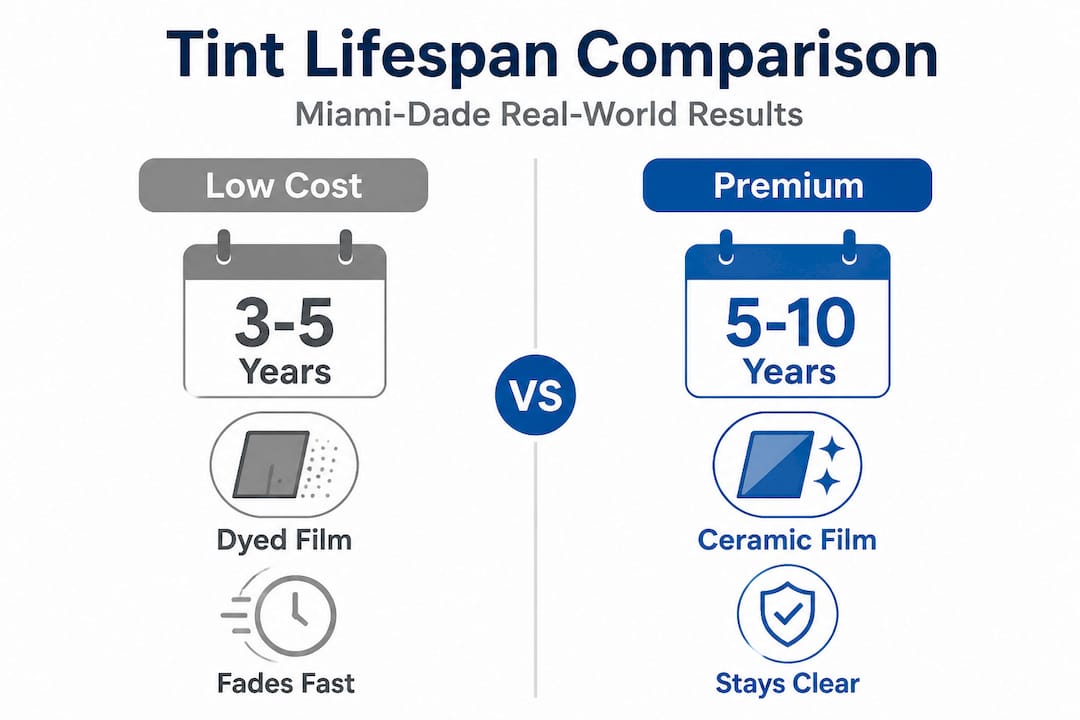
Metalized or hybrid films step it up. These films use metal particles to reflect heat rather than absorb it, which reduces degradation. You can expect 5 to 7 years from a well-installed metalized film before noticeable performance drops.
Ceramic films are the top tier. Products like 3M IR, 3M Color Stable, and Iviron Kollmax ceramic tint are built differently. The ceramic particles are non-conductive and non-metallic, which means they don't interfere with electronics and they resist heat-related breakdown far better. Ceramic tints longevity is well documented, and the window tint durability data on these films consistently puts them at 8 to 10 years or more with proper care.
Here is a comparison of how film types stack up in a Miami-Dade context:
| Film type | Avg. lifespan in Miami | UV protection | IR heat rejection |
|---|---|---|---|
| Dyed film | 2 to 4 years | Moderate (60-70%) | Low (20-30%) |
| Metalized/hybrid | 4 to 7 years | Good (80-90%) | Moderate (40-60%) |
| Ceramic film | 8 to 12+ years | Excellent (99%) | High (60-97%) |
The ceramic numbers are not marketing language. Ceramic films block 99% UV and reject between 60 and 97 percent of infrared heat, maintaining their optical clarity after 50,000 kilometers of extreme condition testing. That kind of empirical performance gives you a clear picture of what you're actually buying.
"When you're investing in window tint for a Miami vehicle or property, the film type is the single biggest predictor of how long it will actually last."
One thing worth understanding is why cheap films fail fast. It's not just the dye fading. Low-quality adhesives break down when exposed to repeated heat cycling, which is what happens every single day in Miami. The adhesive softens, air gets trapped, and bubbles form. Once bubbling starts, the film is done.
Factors that influence tint longevity in Miami
With the average lifespans established, it's important to examine what actually affects tint durability, especially in Miami's environment. The climate here is not typical. You're dealing with intense UV radiation, high humidity, salt air near the coast, and temperatures that push well past 90 degrees Fahrenheit for months at a time.
Miami's climate impact on tint is substantial. UV radiation is the primary aging agent for any film. Miami sits at a low latitude, which means solar intensity is higher year-round compared to northern states. A film that lasts 7 years in Chicago might only hold up for 4 years in Hialeah under the same conditions if it's a lower-grade product.
Humidity adds another layer of stress. Moisture can work into the edges of poorly installed tint, weakening the adhesive bond at the seams. This is why you see peeling edges on older, budget-installed tint jobs across Miami-Dade. The weather effects on tint are cumulative and compound each other.
Here's a breakdown of the key variables:
Factors that shorten tint life:
- Direct sun exposure for extended daily periods
- High ambient humidity that penetrates edge seals
- Poor surface prep before installation
- Using ammonia-based cleaners after installation
- Rolling down windows too soon after installation
- Choosing dyed or low-grade films to save money upfront
Factors that extend tint life:
- Ceramic film construction with stable adhesive formulas
- Professional installation with thorough surface decontamination
- Parking in covered or shaded spots regularly
- Gentle, pH-neutral cleaning products
Ceramic films maintain clarity and full performance after extreme condition testing, which confirms that film quality is not just a comfort upgrade. It directly determines longevity in environments like ours.
Installation quality is where many people get surprised. Even a great ceramic film will fail early if the glass isn't properly prepped. Contaminants left on the surface during install create micro-bubbles that grow over time. The difference between a film that lasts 4 years and one that lasts 10 is often the installer, not just the film.
Pro Tip: For residential and commercial tint, south-facing windows see significantly more UV stress than north-facing ones. If you're prioritizing budget, allocate your highest-quality film to those southern exposures first.
Signs your window tint needs replacing
Understanding what can shorten tint lifespan is key, so let's explore how to spot when your tint needs attention or replacement. Catching problems early can sometimes mean a repair or partial replacement rather than a full redo.
Here are the most common signs that your tint has reached the end of its useful life:
- Bubbling or blistering. This is the most obvious sign. Bubbles mean the adhesive has failed. Once they start forming, they spread. No amount of pushing them down fixes the underlying problem.
- Purple or color-shifted tint. Dyed films lose their black or charcoal color and turn purple when the dye breaks down. If your tint looks purple in bright sunlight, it's no longer blocking UV effectively.
- Peeling edges. Edges are where heat and humidity attack first. Peeling at the corners or along the bottom seal is a clear signal that adhesive failure has started.
- Scratches or hazing. Surface damage from abrasive cleaning or sharp objects creates areas that scatter light and reduce clarity. Heavy hazing means optical performance is compromised.
- Loss of heat and glare control. If your car or room feels noticeably hotter than it used to with the tint in place, the film has degraded. This is a performance indicator, not just an aesthetic one.
- Cracks or delamination. In older or very cheap films, the layers can separate or crack under repeated thermal expansion and contraction.
"The best time to catch tint problems is before summer in Miami, not after. A quick inspection in late spring can save you the cost of a full replacement."
Ceramic films maintain clarity after extensive extreme-condition testing, which means these signs appear far less often and far later in the film's life when you start with a quality product.
For practical window tint maintenance, annual visual checks are a good habit. Before and after Miami summers is the best schedule, since the intense heat stress of July and August can accelerate issues that were minor in the spring.
Pro Tip: Check your tint against a bright sky or light-colored wall. This makes surface hazing, micro-bubbles, and color shifts much easier to spot than inspecting against a dark background. If you notice any yellowing or reduced clarity, schedule an inspection immediately. And before the hottest months arrive, review summer tinting tips to stay ahead of heat-related wear.
How to maximize window tint lifespan
Knowing when replacement is needed, the next step is understanding how to keep your tint performing well for as long as possible. Most tint failures in Miami are preventable with simple, consistent care habits.
Cleaning practices matter more than most people realize. Ammonia-based glass cleaners, which are in many common household products, degrade the adhesive and dye in window films over time. The damage is gradual, so people don't connect the product to the problem. Stick to pH-neutral or tint-safe glass cleaners. A soft microfiber cloth is all you need.
Avoid anything sharp or abrasive near tinted glass. This includes suction cups for phone mounts if they have rough edges, ice scrapers in cooler months, and stiff brushes during car washes. Even repeated friction from rough fabrics can cause micro-scratching that accumulates into noticeable hazing.
Tint maintenance tips from experienced installers consistently point to parking habits as a major factor. Cars that park in covered garages or shaded spots daily show significantly less tint degradation than vehicles left under direct sun all day. If covered parking isn't an option, a windshield sunshade and side window covers are a meaningful investment.
Here are the core maintenance habits for maximizing tint life in Miami:
- Wait at least 5 to 7 days after installation before rolling windows down or cleaning the glass. The adhesive needs time to fully cure in Miami's heat and humidity.
- Clean with microfiber only. No paper towels, no rough cloths.
- Use ammonia-free cleaners. Spray onto the cloth, not directly onto the glass.
- Inspect edges seasonally. Catch adhesive lifting before it spreads.
- Schedule a professional inspection annually. An experienced installer can spot early-stage issues that aren't obvious to an untrained eye.
- For home and commercial tint, make sure window frames and seals are in good condition. Gaps in seals allow moisture to work into the edges of the film.
Ceramic films maintain clarity after extreme testing conditions, which shows that their structural integrity responds well to proper maintenance. You're not fighting against the film's limitations. You're supporting its natural durability with simple routines.
Pro Tip: For commercial properties with large glass panels, a semi-annual professional cleaning of the exterior glass prevents dirt and grime from building up in ways that can trap heat against the film surface and accelerate aging.
Our experience: What most guides miss about Miami tint longevity
Most tint guides talk about average lifespans as if they apply equally everywhere. They don't. Installing films in Miami-Dade across hundreds of vehicles and properties has made one thing very clear. The gap between what a film does in a lab-average environment and what it does in Coral Gables or Doral in August is significant.
Generic guides also tend to lump all ceramic films together. That's not accurate either. Not every film labeled "ceramic" is built to the same standard. Products like 3M IR and Iviron Kollmax go through documented empirical testing. You can look at actual performance data. Films that reject 60 to 97% IR heat and block 99% UV while maintaining clarity through 50,000 kilometers of extreme testing are a different category from budget films with loose "ceramic" marketing.
What most guides also miss is the installer variable. Miami's climate punishes shortcuts harshly. A film installed on a surface with even minor contamination will start showing problems within 12 to 18 months in this environment. Somewhere drier or cooler, that same shortcut might not show visible consequences for 3 to 4 years. The climate doesn't forgive sloppy prep work.
We also find that property owners especially overlook tint as a maintenance item. Car owners tend to notice changes because they're inside the vehicle daily. Home and commercial property owners often don't notice degrading tint until it's severely compromised. Understanding the ceramic tint benefits beyond aesthetics, like actual energy cost reduction and UV protection for interiors, helps property owners treat tint as the functional investment it is rather than a cosmetic detail.
Annual reviews are not just a sales recommendation. After a Miami summer, films that were borderline in the spring often show clear signs of failure. Catching that before the following summer prevents a complete replacement from being a rushed, reactive expense.
Get reliable window tinting for Miami-Dade vehicles and properties
Knowing what separates a quality tint from a short-lived one gives you the advantage when making this decision. The next step is making sure that knowledge translates into real results for your vehicle or property.
We provide mobile window tinting across Miami-Dade for cars, homes, and commercial spaces using 3M IR, 3M Color Stable, and Iviron Kollmax ceramic films. These are the films that back up their performance claims with real data. Our ceramic tint service comes to your location, which means no waiting at a shop and no disrupting your schedule. For those evaluating materials, our 3M ceramic film options offer a range of performance levels to match your priorities. And if you want a clear picture of what this costs before committing, our Miami tint prices page breaks it all down transparently. Get in touch to schedule your installation.
Frequently asked questions
How long does window tint typically last in Miami?
Quality window tints, especially ceramic, often last 5 to 10 years in Miami before major signs of wear appear. Ceramic films maintain clarity after extensive testing, which supports that long lifespan even in Miami's harsh conditions.
Does extreme heat reduce the lifespan of window tint?
Yes, heat and intense UV exposure in Miami can cause low-quality tint to fade or peel much sooner than expected. Ceramic films block 99% UV and reject up to 97 percent of infrared heat, which is what makes them far more resilient in this climate.
What are the most durable window tint types?
Ceramic window tints are the most durable option and resist fading, peeling, and clarity loss over many years. Empirical benchmarks confirm that ceramic films reject 60 to 97 percent of IR heat, block 99 percent UV, and maintain clarity after 50,000 kilometers of extreme condition testing.
How can I tell if my window tint needs replacing?
Look for bubbling, cracks, fading color, peeling edges, or reduced heat and glare control inside your vehicle or space. These signs all indicate the film has broken down and needs replacement. Ceramic films maintain clarity far longer, so these issues are much rarer and appear later with quality materials.
How can I extend the lifespan of window tint?
Regular cleaning with ammonia-free products, avoiding sharp objects near the glass, and parking in shaded areas all help extend tint life in Miami. Ceramic films maintain clarity after extreme testing, confirming that consistent maintenance supports and preserves their built-in durability.