
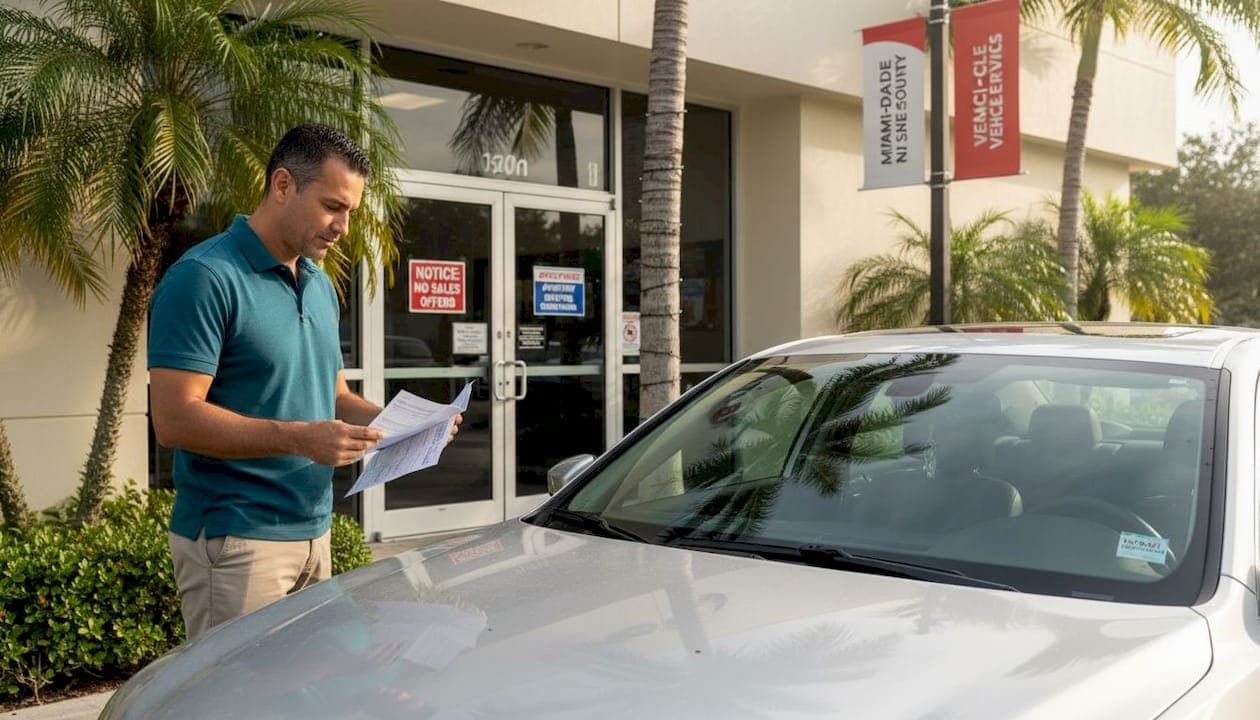
You already know the brands. You've heard of 3M, you've seen the Iviron Kollmax ceramic spec sheets, and you've compared VLT percentages online. But here's what most Miami-Dade drivers discover too late: knowing a brand name is not the same as understanding the numbers on the installation receipt. Misreading one spec can mean a traffic stop on I-95, a failed inspection in Miami-Dade County, or a car that still bakes in the Brickell parking garage despite having "premium" film installed. This guide cuts through the terminology fog so you can shop smarter, talk to installers with confidence, and stay legal.
Table of Contents
- Why industry terms matter for Miami-Dade vehicle owners
- Breaking down essential window tint terms
- Translating window tint specs: What VLT, TSER, and others actually mean for your car
- How to talk to your installer: Avoiding common pitfalls
- What most Miami drivers miss about window tint industry terms
- Get expert window tint advice and precision installation in Miami
- Frequently asked questions
Key Takeaways
| Point | Details |
|---|---|
| Know your legal terms | Understanding VLT and AS-1 is crucial for Miami window tint compliance. |
| Clarify heat rejection metrics | Always ask your installer what measurement method is behind their numbers. |
| Don’t fall for jargon | Industry lingo can mask key differences, so get clear explanations when shopping. |
| Communicate clearly with pros | Use correct terms and ask direct questions to avoid costly mistakes. |
| Legal doesn't always mean optimal | Choosing the right tint means balancing compliance, aesthetics, and comfort. |
Why industry terms matter for Miami-Dade vehicle owners
Window tint language is not just technical decoration. Every term an installer uses connects to something real: Florida law, product performance, or your wallet. When an installer quotes a percentage and you nod along without knowing what it means, you hand over control of the entire decision.
The stakes in Miami-Dade are specific. Florida's climate pushes drivers toward darker films for heat control, but the law draws hard lines that many first-time buyers discover only at a traffic stop. As Florida tint laws outline, front-side windows must allow at least 28% VLT, windshield tint is restricted above the AS-1 line, and it must be non-reflective. Rear windows have more flexibility depending on vehicle type, but the front-side rule is firm and commonly cited in enforcement.
Understanding local regulations before you walk into a shop also changes the conversation entirely. Instead of trusting whatever an installer recommends, you arrive knowing the baseline requirements. You can ask whether a product meets the 28% VLT threshold and actually interpret the answer. That knowledge protects you from well-meaning but compliance-vague installers who prioritize aesthetics over legality.
Here is why the terminology gap causes real problems for Miami drivers:
- Compliance confusion: Drivers assume darker means illegal, but a high-IRR ceramic film at 35% VLT is both legal and high-performing.
- Overpaying for the wrong film: Without understanding TSER, you can't compare two films claiming "70% heat rejection" if one is measuring IRR and the other is measuring TSER.
- Installer miscommunication: Asking for "the darkest legal tint" without specifying the measurement standard can produce wildly different results.
- Failed inspections: A misread spec leads to re-tinting costs and potential fines.
Knowing what what you can and cannot do under Miami-Dade tinting rules is the single fastest way to avoid expensive mistakes and protect your investment.
Breaking down essential window tint terms
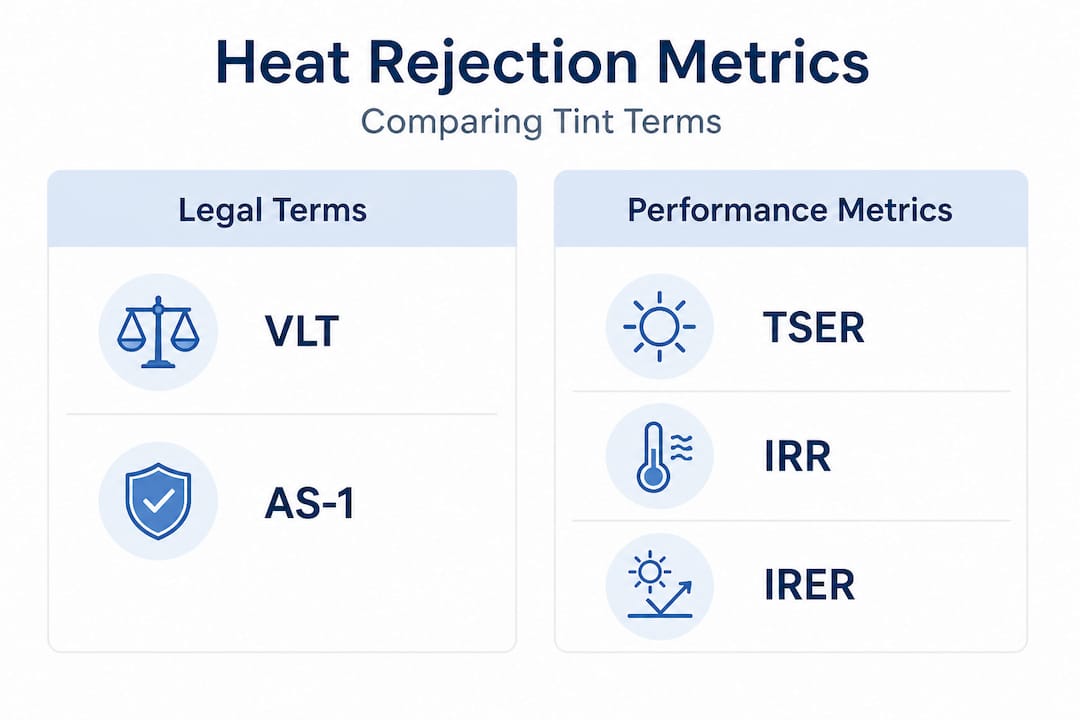
Let's get into the actual vocabulary. These are the terms you will see on product spec sheets, installer quotes, and marketing materials. Some are legal terms. Some are performance metrics. The difference matters.
VLT (Visible Light Transmission): This is the percentage of visible light a film allows through. A 20% VLT film blocks 80% of visible light. Lower numbers mean darker tint. This is the primary legal metric in Florida.
AS-1 line: This is a line marked by the vehicle manufacturer near the top of the windshield. Florida law restricts tint above this line and requires that it be non-reflective. You'll typically see it etched into the glass itself.
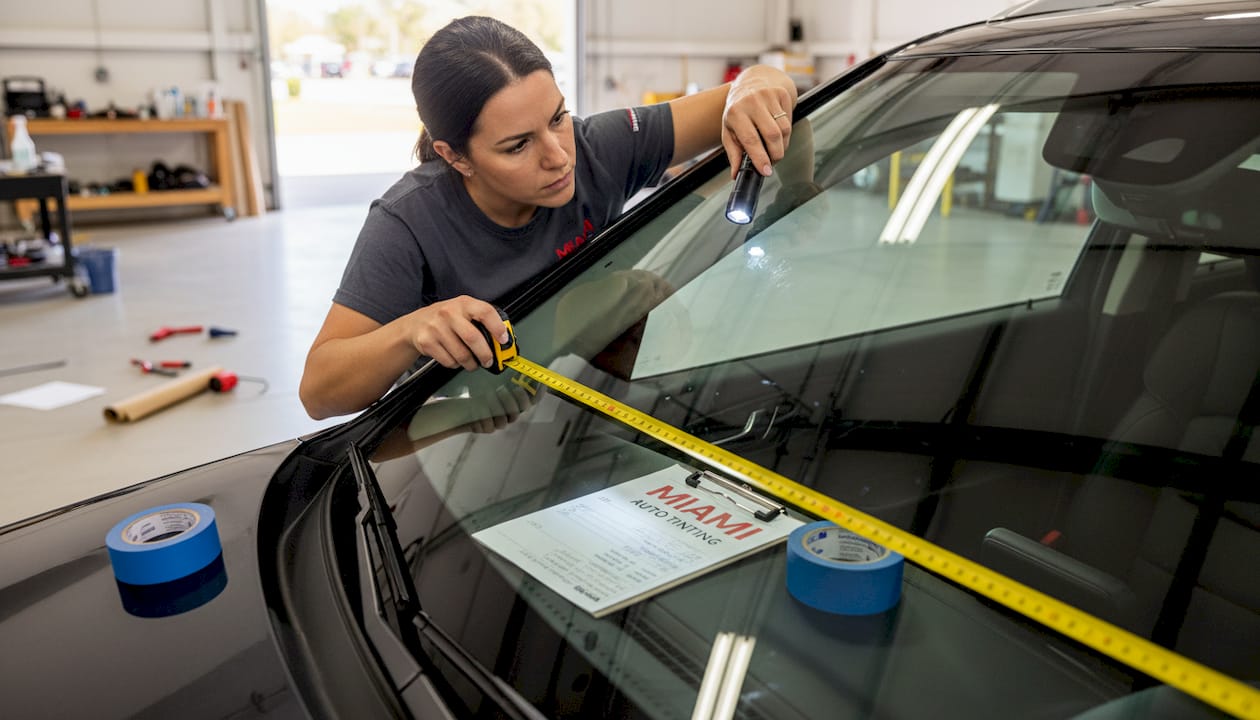
TSER (Total Solar Energy Rejected): This measures the percentage of total solar energy a film blocks, including visible light, UV rays, and infrared heat. A film with 65% TSER blocks 65% of all incoming solar energy. This is often cited in quality product comparisons.
IRR (Infrared Rejection Rate): This measures how much infrared radiation a film rejects, usually at a specific wavelength range (often 900 to 1,000 nanometers). High-performance ceramics like the Iviron Kollmax are often marketed using IRR because ceramic technology excels specifically in the infrared spectrum.
IRER (Infrared Energy Rejection): Similar to IRR but measured across a broader wavelength range. The distinction sounds minor but can cause a 70% IRR film to show dramatically different numbers when measured as IRER across a wider spectrum.
As industry analysis reveals, different products and installers may cite TSER, IRR, or IRER interchangeably in marketing, even though these metrics can produce very different numbers depending on the measurement range used. This is not necessarily dishonest, but it creates an apples-to-oranges comparison problem that catches even experienced buyers off guard.
Here's a quick-reference table to keep these straight:
| Term | What it measures | Legal or performance metric | Key question to ask |
|---|---|---|---|
| VLT | Visible light allowed through | Legal | What percentage is this film? |
| AS-1 line | Top windshield boundary | Legal | Does the tint stay below it? |
| TSER | Total solar energy rejected | Performance | Is this whole-spectrum or partial? |
| IRR | Infrared rejection at a specific wavelength | Performance | What wavelength range was tested? |
| IRER | Infrared rejection over broader spectrum | Performance | What nm range does this cover? |
Pro Tip: When comparing two films on heat rejection, always ask both the metric name and the wavelength range used. A film showing 96% IRR at 900nm is not directly comparable to one showing 70% IRER across 780 to 2,500nm. Both claims can be true, and both can mislead you if you don't know which scale was used.
You can explore more detailed coverage in our broader window tinting guide and find out how tinting myths debunked can reshape your expectations before you commit.
Translating window tint specs: What VLT, TSER, and others actually mean for your car
Understanding the definitions is one thing. Translating them to the reality of driving in Miami is another. Let's put these terms to work in practical Miami scenarios.
Scenario one: The "it's just for looks" buyer. A driver wants a sleek dark appearance and requests 15% VLT on all windows. The installer complies. The result? The front side windows are now illegal under Florida tint laws, which require at least 28% VLT on front side windows for most vehicles. The driver gets pulled over two weeks later and pays for removal plus re-tinting. The error had nothing to do with film quality and everything to do with not knowing one legal threshold.
Scenario two: The "I want maximum heat rejection" buyer. A driver in Coral Gables compares two films: Film A claims "70% heat rejection" and Film B claims "60% heat rejection." Film A seems like the obvious winner. But Film A is measuring IRR at a narrow 900nm wavelength while Film B is measuring TSER across the full solar spectrum. In Miami's real-world conditions, Film B actually keeps the car cooler during daytime driving because it addresses the full range of solar energy entering the vehicle.
These scenarios aren't hypothetical edge cases. They represent the most common misunderstandings we see on a weekly basis here in Miami-Dade.
Here's how to map the specs to real driving situations:
- Legal first: Confirm VLT compliance for front side windows (28% minimum) and windshield positioning (above AS-1 only, non-reflective).
- Comfort second: Look at TSER for overall heat management in daily Miami driving, especially in bumper-to-bumper I-95 or Palmetto traffic.
- UV protection third: Most quality films, including both 3M IR and Iviron Kollmax, block 99% of UV rays regardless of darkness, so this is often a non-issue with premium products.
- Aesthetics last: VLT percentage will largely determine how the car looks, but you have options within every legal range.
The comparison table below shows how common VLT levels interact with Miami's legal environment and your comfort:
| VLT percentage | Legal for front side windows? | Visible darkness level | Typical Miami use case |
|---|---|---|---|
| 50% | Yes | Very light | Subtle, keeps factory look |
| 35% | Yes | Medium dark | Popular daily driver choice |
| 28% | Yes (barely legal) | Dark | Maximum legal for front sides |
| 20% | No (front side) | Very dark | Rear windows on SUVs/sedans |
| 5% | No (front side) | Limo dark | Rear only, SUVs with dual rear glass |
When comparing local tint laws across different Florida counties, you'll also find that enforcement priorities vary, but front-side VLT at 28% is consistently the line in Miami-Dade. Detailed local regulations and requirements spell out exactly where the boundaries sit so there are no surprises after installation.
How to talk to your installer: Avoiding common pitfalls
Knowing the vocabulary is only useful if you actually use it in the conversation. Here's how to apply what you've learned when speaking with a tint installer in Miami.
The most common mistake is relying entirely on brand name and shade description. Saying "I want the 3M stuff, medium dark" gives your installer almost no usable information. The 3M lineup alone includes multiple product families with different TSER values, VLT options, and performance profiles. You need to be more specific.
These are the questions worth asking every time:
- "What is the VLT on this film for front side windows?" This one question immediately checks legal compliance.
- "Is this film compliant with Florida's 28% front-side rule?" Ask directly so there's no ambiguity.
- "When you say heat rejection, are you quoting TSER, IRR, or IRER?" This forces clarity on performance claims.
- "What wavelength range is used for the IRR measurement?" This separates the narrow-spectrum marketing claims from the full-spectrum reality.
- "Do you have a spec sheet for this film I can review?" Legitimate installers always have product spec sheets.
As heat rejection metric analysis confirms, different products and installers cite entirely different metrics for heat rejection, and asking which method is used eliminates the marketing confusion that catches buyers off guard.
Pro Tip: Bring a printed copy of your desired spec to the conversation. For example: "I want a front-side film that is at least 28% VLT, at least 50% TSER, and rejects 90% or more of infrared at tested wavelengths." This eliminates the guesswork for both you and the installer.
The DIY vs. pro tinting question comes up often, and one major reason professional installation wins in Miami is exactly this: certified installers know how to match product specs to local law without cutting corners.
What most Miami drivers miss about window tint industry terms
Here's the honest truth that even enthusiasts don't always want to hear: memorizing industry terms is useful, but it can also create a false sense of security. We've seen drivers walk in citing TSER and IRR correctly, then still get a non-compliant install because they didn't ask the one simple question that mattered: "Is this specific film, at this specific VLT percentage, legal for my front side windows under Florida law?"
The mismatch between marketing language and legal language is real. A film can have 99% IRR and still be illegal if it drops below 28% VLT on your front windows. The performance numbers and the legal numbers live in completely different categories, and confusing them is the most expensive mistake a Miami driver can make.
We've also noticed that overconfidence with specs can blind drivers to the actual installation quality. A perfectly specced film installed with bubbles, poor edge adhesion, or misaligned cutlines delivers worse performance in Miami's humidity and heat than a slightly less impressive spec installed flawlessly. Numbers on a sheet are only as good as the hands that apply the film.
The practical wisdom here is to ask for documentation and trust verifiable evidence over verbal assurances. Ask for the spec sheet, cross-check the VLT against tinting myths you've already debunked, and confirm compliance in writing before the installation starts. The drivers who never have problems in Miami-Dade are the ones who ask one extra question rather than assume everything is handled.
Get expert window tint advice and precision installation in Miami
You now have the vocabulary, the legal benchmarks, and the right questions to ask. Putting all of this into practice is the part where having the right installation partner makes the biggest difference.
At South Miami Tint, we bring the installation to you anywhere in Miami-Dade. Whether you're at home in Kendall or at the office in Brickell, our mobile team arrives with a full selection of ceramic window tint options, including 3M ceramic film and Iviron Kollmax, all installed with current knowledge of Florida's compliance requirements. We provide spec sheets upfront, quote in plain numbers you now understand, and never oversell a film that doesn't fit your legal or performance needs. Check out our tint service prices for transparent, no-surprise pricing that matches your specific vehicle and goals.
Frequently asked questions
What does VLT mean and why is it important in Miami?
VLT stands for Visible Light Transmission, and Florida's front-side minimum of 28% makes it the most important legal threshold for Miami-Dade drivers to know before choosing any film.
How is "heat rejection" really measured in window tint?
Heat rejection is measured using TSER, IRR, or IRER, and as industry metric analysis shows, numbers can vary significantly depending on which scale and wavelength range the manufacturer uses.
What's the AS-1 line on a windshield?
The AS-1 line is a manufacturer-marked boundary near the top of your windshield, and Florida law permits only non-reflective tint above this line, making it a critical reference point for any windshield film application.
Is darker always better for protecting my car?
Darker tint does not equal better protection, because heat rejection metrics like TSER and IRR determine actual thermal performance, and a lighter ceramic film can outperform a much darker dyed film in Miami's heat.
Recommended
- Comparing Window Tinting Laws in Miami and Surrounding Areas
- Local Regulations on Car Window Tinting in Miami
- Comparing Window Tint Options: Which is Right for Your Miami Vehicle?
- How Miami’s Climate Affects Your Car Window Tinting Choices
- Top 6 Clear Bra Solutions Fort Lauderdale 2026 - Many Ceramic Pro Touch