
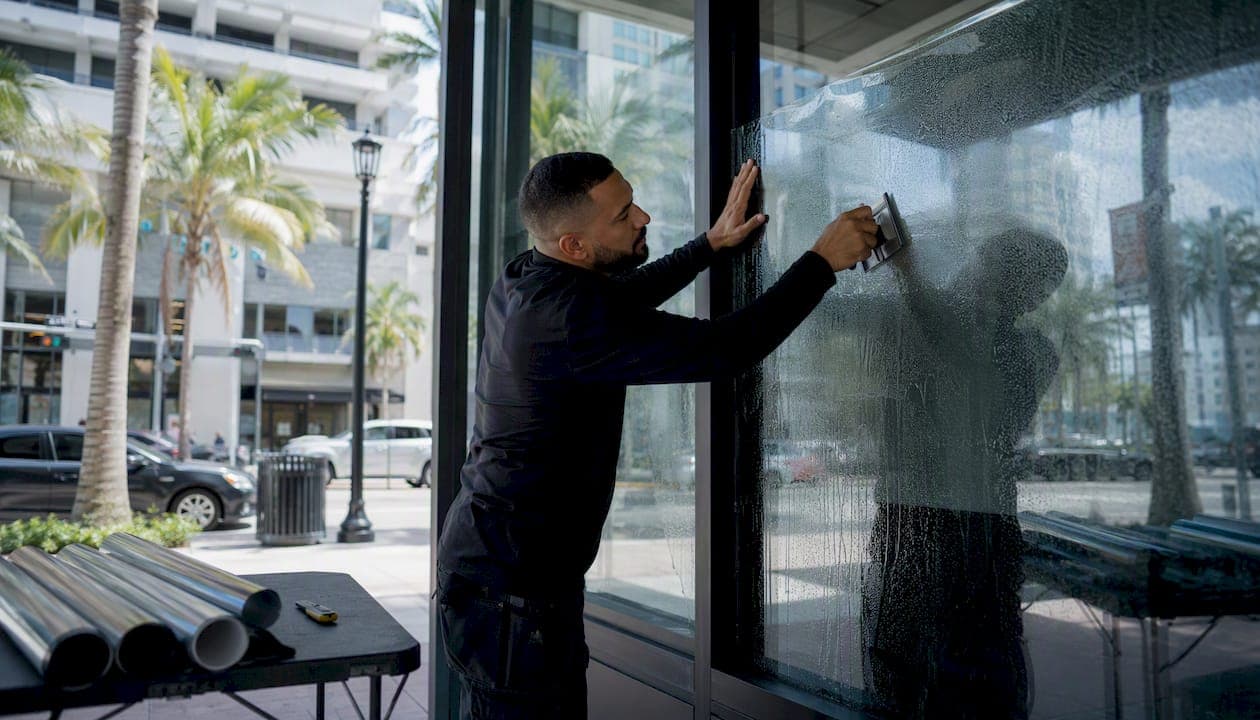
For Miami‑Dade commercial properties, the right call is on-site installation of ceramic solar/privacy film on street-facing glass and frosted or decorative film inside conference rooms. Southmiamitint installs 3M Ceramic IR, 3M Color Stable, 3M Crystalline, and Iviron KoolMax ceramic tint directly at your location, with no downtime and no need to haul glass anywhere.
Quick film-to-space map:
- Storefronts and exterior façades: 3M Ceramic IR or Iviron KoolMax for heat rejection, UV blocking, and daytime privacy without darkening the interior.
- Conference rooms and private offices: Frosted or decorative film for full sightline control while keeping natural light. Privacy levels in window film range from light diffusion to near-opaque, so you can match the spec to the room.
- Secure or sensitive areas: Blackout or dual-reflective film for maximum visual privacy.
Schedule a mobile site survey this week and get a measured proposal with exact VLT and IR numbers for your glass. Southmiamitint is a certified installer carrying manufacturer warranties on every 3M and Iviron product.
Pro Tip: Ask your installer for the SHGC and VLT spec sheet for the film you select before signing anything. Those two numbers tell you exactly how much heat and light the film will pass, so there are no surprises after installation.
Key Takeaways
Ceramic privacy film installed by a certified dealer is the most cost-effective commercial privacy upgrade for Miami‑Dade properties, combining heat rejection, UV protection, and sightline control in a single product.
| Point | Details |
|---|---|
| Match film to space | Storefronts: 3M Ceramic IR or Iviron KoolMax. Conference rooms: frosted/decorative. Secure areas: blackout or dual-reflective. |
| Energy ROI | High-performance films can cut cooling costs 15–30%; Florida payback typically runs 2–4 years. |
| Curing expectation | Allow 30–60 days for full cure; temporary haze is normal and clears without intervention. |
| Certification matters | Only a 3M Authorized Dealer can register the manufacturer warranty; always verify before booking. |
| Southmiamitint | Mobile on-site installation across Miami‑Dade with 3M and Iviron films, written proposals, and same-week scheduling. |
Table of Contents
- What advanced privacy film options are available for commercial spaces?
- How do you specify the right privacy level for your building?
- What does professional on-site installation actually involve?
- How long do commercial privacy films last, and what warranties apply?
- What does commercial window film cost, and what energy savings can you expect?
- What is the typical project timeline from survey to completion?
- Full cost breakdown: film, labor, permits, and maintenance
- What I see on every Miami‑Dade commercial site visit
- Book your on-site measurement with Southmiamitint
- Manufacturer and technical resources
- Sources
What advanced privacy film options are available for commercial spaces?
One-way reflective films are the most common upgrade for ground-floor offices. They give daytime exterior privacy by reflecting the view from outside while preserving your outward sightlines. The catch: dual-reflective films reverse at night when interior lighting is brighter than outside, so 24/7 privacy requires pairing them with interior frosted bands or blackout sections.
Digital screen-cloaking film is a newer option for presentation rooms. It uses a micro-louver structure that makes laptop and monitor screens unreadable from oblique angles, protecting sensitive data during client meetings without blocking ambient light.
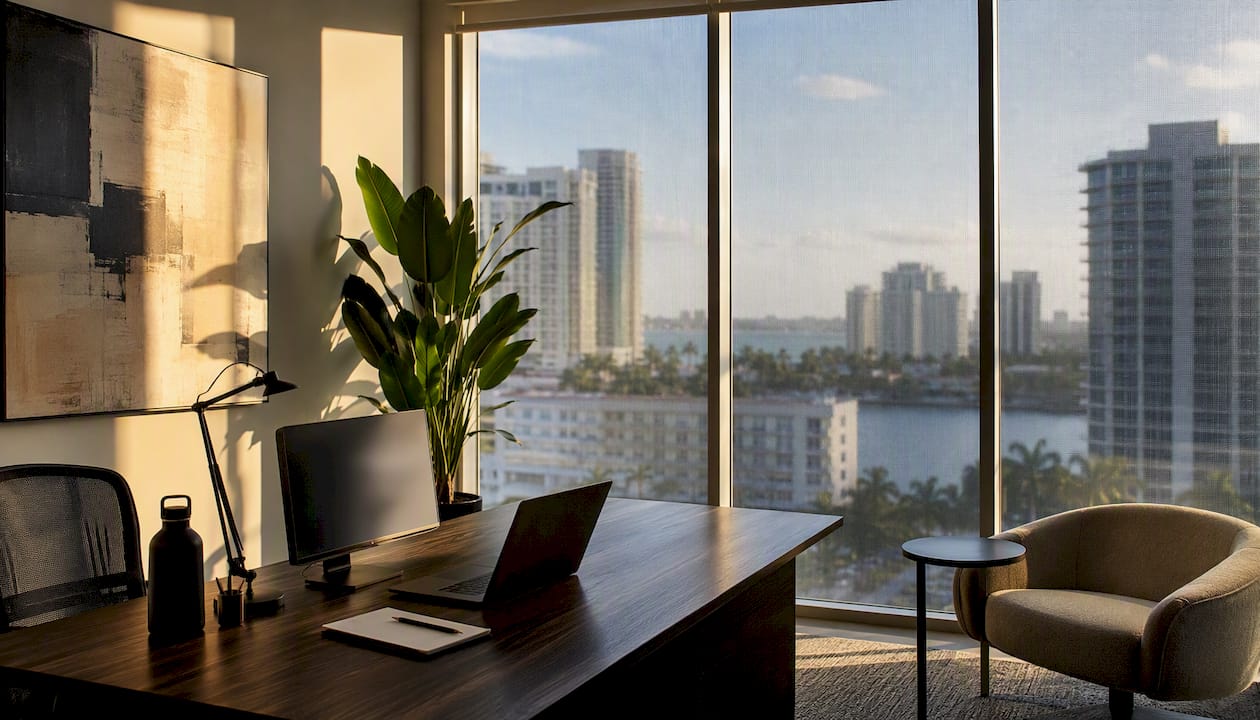
Smart or switchable film goes further: it transitions from clear to frosted on demand via a wall switch or app. It costs more upfront but eliminates the need for blinds or curtains entirely, which is practical for healthcare exam rooms or executive boardrooms where privacy needs shift throughout the day.
How do you specify the right privacy level for your building?
Start with three numbers: VLT (visible light transmission), IR rejection, and UV blocking. Specification should begin with measurable targets before choosing a film type. A film with 35% VLT passes about a third of visible light, which reads as moderately tinted from outside and comfortably lit inside. Drop to 15% VLT for stronger privacy; go above 50% when daylight retention matters more than sightline control.
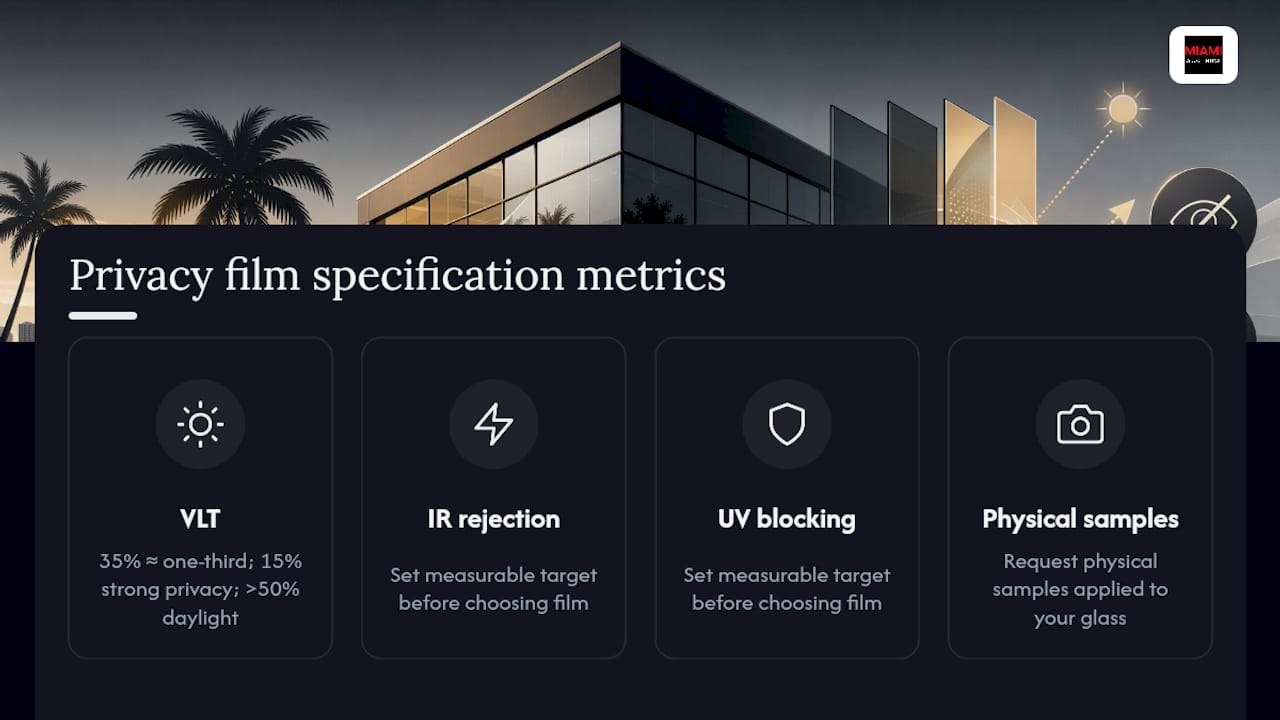
For patterned or branded glass, frosted vinyl and etched-look films accept custom logos and geometric cuts. Your installer should provide physical samples applied to your actual glass before you commit, since the same film reads differently on tinted, low-E, or clear glass.
What does professional on-site installation actually involve?
Certified installers matter because film adhesion depends on glass prep, water chemistry, and application technique. The wet application method uses a slip solution to float the film into position, then a squeegee pushes water and trapped air outward from the center. On specialty or low-E glass, construction affects film performance and some films require exterior application or specialized adhesives.
Expect a 30–60 day curing window after installation. Temporary haze or small moisture pockets are normal during this period and resolve on their own. A professional installer briefs you on this upfront so you do not mistake curing for a defect.
Mobile installation means the crew comes to your property with all equipment. No scheduling around a shop's hours, no transporting panels. For Miami‑Dade commercial accounts, same-week installation is often available.
How long do commercial privacy films last, and what warranties apply?
Quality ceramic films from 3M and Iviron carry manufacturer warranties that cover delamination, bubbling, and color shift. 3M's commercial film warranties are registered by the installing dealer, so using a 3M Authorized Dealer is the only way to activate that coverage. Iviron KoolMax carries its own manufacturer warranty on ceramic products.
Properly installed film on interior glass typically lasts 10–15 years. Exterior-applied film faces more UV and weather exposure and may have a shorter service life depending on the product line. Cleaning with a soft cloth and ammonia-free solution keeps the film performing without scratching the coating.
What does commercial window film cost, and what energy savings can you expect?
Cost drivers are film type, total glass surface area, glass type, and whether security or hurricane film is added. Florida businesses commonly recover film costs through HVAC savings over a multi-year period, and high-performance films can cut cooling costs by a significant percentage while blocking nearly all UV. That UV protection also extends furniture, flooring, and merchandise life, which adds measurable ROI beyond the energy line.
Modern ceramic films can reject a high share of heat on some product lines, making them the strongest performers for Miami's climate. Entry-level dyed or carbon films cost less upfront but deliver lower IR rejection and fade faster.
What is the typical project timeline from survey to completion?
- Site survey (Day 1): Installer measures all glass, checks glass type, reviews orientation, and applies sample film swatches.
- Written proposal (Days 1–3): You receive a measured quote with film specs, VLT/IR numbers, labor, and warranty details.
- Scheduling (Days 3–7): Installation is booked; most Miami‑Dade commercial jobs are completed in one visit for standard office suites.
- Installation day: Crew arrives with film, tools, and slip solution. Work is done on-site with minimal disruption.
- Curing period (30–60 days): Film bonds fully; temporary haze clears without any action needed on your part.
Full cost breakdown: film, labor, permits, and maintenance
- Film material: Ceramic and spectrally selective films (3M Ceramic IR, Iviron KoolMax) run higher per square foot than standard dyed films. Frosted and decorative films are priced by the cut and pattern complexity.
- Labor: Charged per square foot or as a flat project rate. Large open-plan facades cost less per square foot than small, divided panes with many edges.
- Permits: Most interior film installations in Miami‑Dade require no permit. Exterior applications on certain historic or HOA-governed buildings may need approval; your installer should flag this during the survey.
- Maintenance: Minimal. No recurring fees. Occasional professional cleaning is optional, not required.
Check mobile window tinting prices for current starting rates and to understand how surface area affects your total.
What I see on every Miami‑Dade commercial site visit
The most common mistake I see is property managers choosing a film based on a photo rather than a physical sample on their actual glass. Tinted, low-E, or reflective glass changes how every film reads. On a site visit, I measure every pane, check the glass spec, and apply a sample swatch so you see the exact result before we order anything.
The wet application step is where quality separates from shortcuts. Proper slip solution, clean glass, and a firm squeegee pass from center outward leave no bubbles and no lifting edges. Clients who have had film installed by uncertified crews often come to us with peeling corners within a year.
As a 3M Authorized Dealer, I register every warranty directly with the manufacturer after installation. You get a written workmanship guarantee from Southmiamitint and the manufacturer's product warranty in your hands before we leave the site.
Book your on-site measurement with Southmiamitint
Southmiamitint brings the full commercial film installation to your Miami‑Dade property: measured site survey, physical film samples on your glass, a written proposal with VLT and IR specs, and same-week installation when your schedule allows.
Your written estimate covers film spec, labor, warranty registration, curing timeline, and any optional add-ons like security or hurricane film. No guesswork, no surprises.
Schedule your mobile site survey or call to get a measured quote for your office, storefront, or facility this week.
Manufacturer and technical resources
Use these sources to verify film specs and warranty terms before you commit:
- Commercial privacy film guide (Engineered Group): film type definitions, conference-room applications, and advanced option explanations.
- Commercial window tinting ROI guide: Florida-specific energy savings and payback timelines.
- Film buyer's checklist: how to check SHGC, VLT, NFRC, and IWFA certifications before purchase.
- 3M ceramic film overview: product-line details and installation specs for 3M Ceramic IR, Crystalline, and Color Stable.
When reviewing any film spec, confirm NFRC or IWFA certification, ask for the SHGC and VLT numbers in writing, and request proof of manufacturer warranty registration from your installer.
Sources
- Commercial privacy window film: Practical office & conference room solutions for privacy and productivity
- Commercial Window Tinting: Energy Savings, Privacy & ROI
- Benefits of Commercial Window Tinting: Complete Guide for Business Owners - Window Tinting - Sun Protection - Solar Film
- How to Choose Commercial Window Film: Buyer's Guide